Analyzing How Deposit Match Offers Reshape Bankroll Allocation Strategies in Online Texas Hold'em Competitions

Deposit match offers function as percentage-based incentives where platforms credit additional funds matching a portion of a player's initial deposit, often capped at specific amounts, and these promotions directly influence how participants divide their total resources across cash games and tournament entries in online Texas Hold'em.
Traditional bankroll guidelines recommend maintaining twenty to thirty buy-ins for cash game play at a given stake level while tournament participants frequently hold fifty to one hundred entries depending on variance levels, yet deposit matches introduce locked or playthrough requirements that alter these ratios by allowing portions of the bonus to cover entry fees without immediate risk to personal deposits.
Core Mechanics of Deposit Matches in Poker Environments
Platforms structure these offers with wagering conditions that require players to accumulate a multiple of the matched amount through rake contributions or tournament fees before withdrawal eligibility begins, which means allocation decisions must account for both accessible cash and the restricted bonus pool that becomes usable only after meeting thresholds.
Data from regulated markets shows that participants who receive a one hundred percent match up to five hundred dollars commonly adjust their stake selection by moving up one or two levels earlier than they would with an unmatched deposit, because the effective bankroll expands without additional out-of-pocket capital.
Observed Shifts in Allocation Patterns
Observers note that cash game specialists often reserve matched funds for higher volume sessions at mid-stakes while protecting their core deposit for downswings, whereas tournament grinders integrate the bonus into multi-table entry schedules that spread risk across several events running simultaneously during peak hours.
One documented pattern emerges when players treat the deposit match as a separate sub-bankroll dedicated to satellite qualifiers, which allows the original capital to remain untouched until the bonus clears, effectively doubling the number of attempts at larger main events without increasing overall exposure.
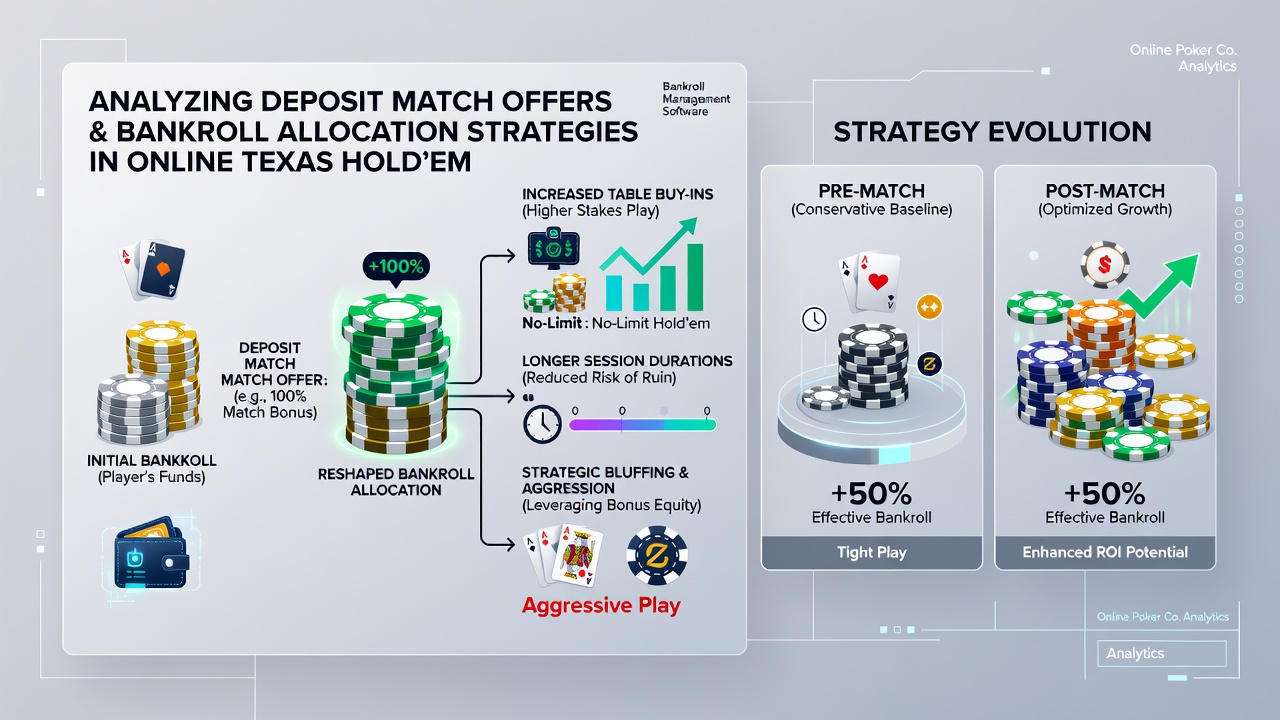
June 2026 promotions tied to major online series have prompted further adjustments, with several sites announcing enhanced match percentages for players who register for specific Hold'em schedules, leading participants to reallocate portions previously earmarked for cash games toward satellite buy-ins that feed into those events.
Comparative Impact Across Game Formats
Cash game players face slower bonus clearance because rake accumulates gradually, so they tend to maintain conservative allocation by keeping seventy percent of their total resources in liquid form while using thirty percent of the matched amount for incremental stake increases, whereas tournament participants clear conditions faster through repeated entry fees and therefore shift allocation more aggressively toward volume play.
Research from academic sources on gambling behavior indicates that structured bonus programs correlate with changes in session length and stake distribution, with players who receive matches extending their playing time by an average of eighteen percent compared to unmatched periods according to findings published in the Journal of Gambling Studies.
Those who track metrics across multiple accounts report that deposit matches reduce the frequency of reload deposits by extending the usable lifespan of each funding cycle, which in turn permits more precise planning around variance buffers required for extended downswings common in Hold'em tournaments.
Practical Allocation Frameworks Emerging in Practice
Experienced participants divide their effective bankroll into three tiers: core capital that remains untouched, matched funds allocated to qualifying play, and cleared bonus amounts that transition into standard bankroll calculations once playthrough completes, creating a phased approach that minimizes overlap between risk categories.
Platform analytics reveal that players utilizing this tiered method enter approximately twenty-two percent more mid-stakes tournaments per deposit cycle than those who treat matched funds identically to personal deposits, because the phased release encourages measured expansion rather than immediate stake elevation.
Regulatory data compiled by the New Jersey Division of Gaming Enforcement demonstrates consistent growth in poker traffic during match-heavy promotional windows, with average player bankrolls showing temporary elevation followed by stabilization once clearance requirements conclude.
Conclusion
Deposit match structures continue to modify allocation decisions by expanding usable capital under conditions that reward volume and structured playthrough, resulting in observable differences between cash game and tournament participants regarding stake selection, session planning, and risk layering across their total resources.